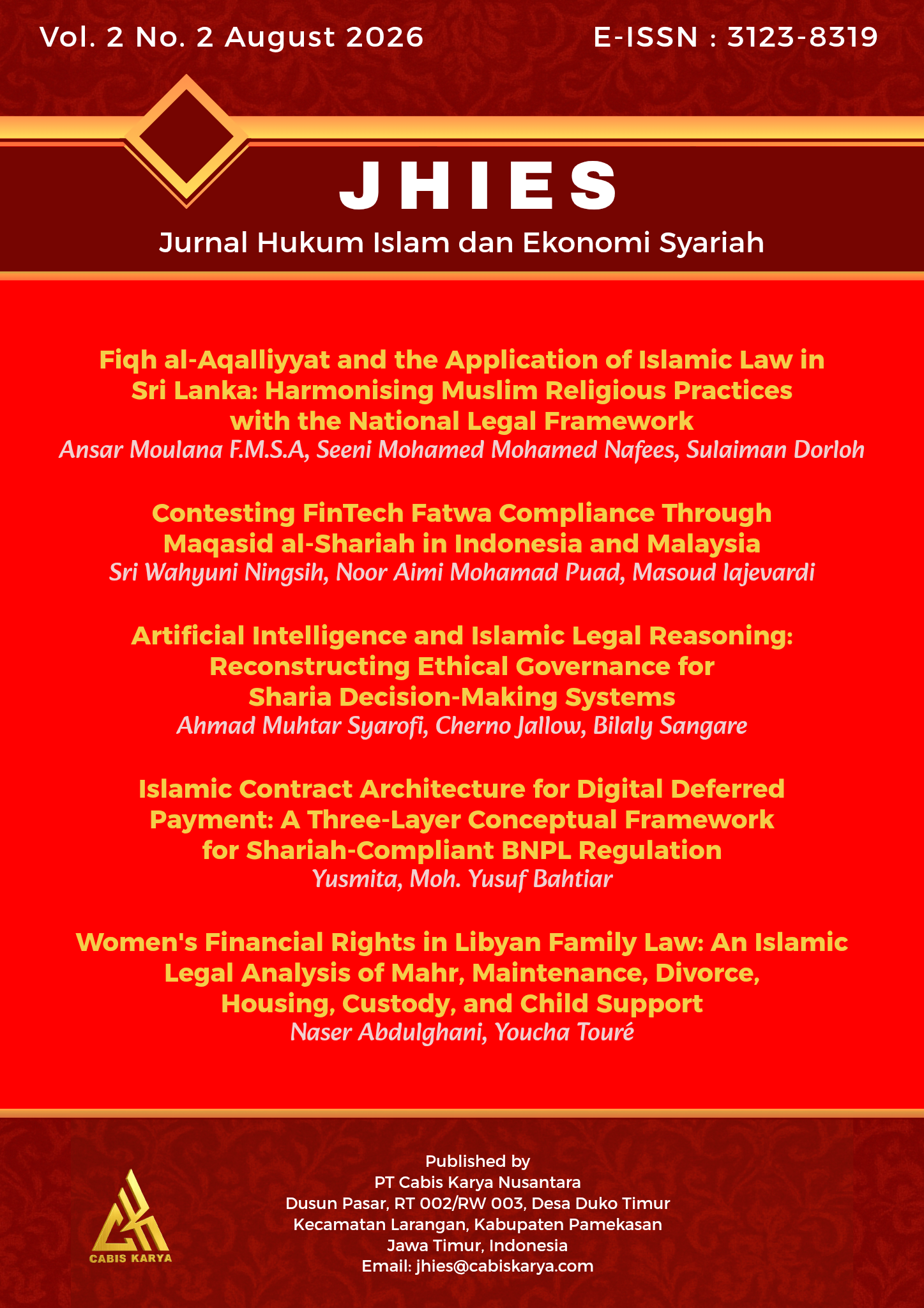
Artificial Intelligence and Islamic Legal Reasoning: Reconstructing Ethical Governance for Sharia Decision-Making Systems
DOI:
https://doi.org/10.67140/jhies.v2i2.18Keywords:
artificial intelligence, islamic law, maqasid al-shariah, ai governance, islamic jurisprudenceAbstract
The development of artificial intelligence (AI) has transformed decision making processes, including those within Islamic law based on ijtihad and maqasid al-shari’ah. However, the integration of AI introduces an epistemological tension between computational logic and normative legal reasoning, which requires moral and methodological justification. This study aims to analyze this tension and reconstruct an ethical governance framework for AI in Sharia based decision making systems. The research employs a qualitative normative conceptual approach based on Scopus indexed literature. The analysis is conducted using content analysis and thematic analysis to identify the relationship between AI governance, usul al-fiqh, and maqasid al-shari’ah. The findings indicate an epistemic discontinuity between AI and Islamic law, particularly the limitations of AI in understanding niyyah, maslahah, and ta’lil al-ahkam. The study also identifies a hybrid epistemic authority model that combines scholars as normative authorities and AI as an analytical tool. While this model enhances efficiency, it risks shifting epistemic authority if not properly governed under Sharia principles. This research proposes a Shariah compliant AI governance framework that integrates maqasid al-shari’ah, AI governance, and ijtihad as mechanisms of epistemic control. AI is positioned as a decision support system under the authority of Islamic scholars. The contribution of this study lies in the development of an Islamic based ethical AI framework and its implications for digital fatwa systems and Sharia AI governance.
Downloads
References
Abedin, B., Meske, C., Junglas, I., Rabhi, F., & Motahari-Nezhad, H. R. (2022). Designing and managing human-AI interactions. Information Systems Frontiers, 24(3), 691–697. https://doi.org/10.1007/s10796-022-10313-1
Ab Rahim, S. F., Ab Rahman, M. F., Abdullah Thaidi, H. A., Nik Mohd Azimi, N. N. M. A., & Jailani, M. R. (2025). Artificial intelligence for fatwa issuance: Guidelines and ethical considerations. Journal of Fatwa Management and Research, 30(1), 77–101. https://doi.org/10.33102/jfatwa.vol30no1.654
Ahmed, A., Masuwd, M., Sabir, M. R., & Mahmudulhassan, M. (2026). Can artificial intelligence perform ijtihad? Authority, epistemology, and legitimacy in digital Islamic jurisprudence. SUHUF: International Journal of Islamic Studies, 38(1), 172–185. https://doi.org/10.23917/suhuf.v38i1.16437
Al-Harbi, H. B. H. A. (2025). The use of artificial intelligence in fatwa (Islamic legal opinion) issuance: A jurisprudential regulatory study. Journal of Arts, 13(3). https://doi.org/10.35696/joa.v13i3.2732
Alafaghani, F. F. (2025). Jurisprudential controls for the use of artificial intelligence: A practical study of "ChatGPT" as a model. Dirasat: Shari'a and Law Sciences, 53(1), Article 10478. https://doi.org/10.35516/Law.2025.10478
Ali, F., Bouzoubaa, K., Gelli, F., Hamzi, B., & Khan, S. (2025). Islamic ethics and AI: An evaluation of existing approaches to AI using trusteeship ethics. Philosophy & Technology, 38(3), Article 120. https://doi.org/10.1007/s13347-025-00922-4
Aspan, H. (2025). From fiqh to code: Reconstructing Islamic legal governance through Maqasid al-Shariah in the era of algorithmic regulation. Journal of Contemporary Islamic Law and Studies, 1(1), 15–27. https://doi.org/10.47353/jcils.v1i1.368
Azwar, A., Usman, A. H., & Abdullah, M. F. R. (2025). Artificial intelligence and Islamic finance: A Scopus-based literature mapping through a PRISMA protocol. Journal of Islamic Law on Digital Economy and Business, 1(1), 65–83. https://doi.org/10.20885/JILDEB.vol1.iss1.art5
Barysė, D., & Sarel, R. (2024). Algorithms in the court: Does it matter which part of the judicial decision-making is automated? Artificial Intelligence and Law, 32, 117–146. https://doi.org/10.1007/s10506-022-09343-6
Booth, W. C., Colomb, G. G., Williams, J. M., Bizup, J., & FitzGerald, W. T. (2016). The craft of research (4th ed.). University of Chicago Press.
Burrell, J. (2016). How the machine "thinks": Understanding opacity in machine learning algorithms. Big Data & Society, 3(1). https://doi.org/10.1177/2053951715622512
Chiao, V. (2024). Algorithmic decision-making, statistical evidence and the rule of law. Episteme, 21(4). https://doi.org/10.1017/epi.2023.27
Coglianese, C., & Ben Dor, L. M. (2021). AI in adjudication and administration. Brooklyn Law Review, 86(3), 791–838. https://brooklynworks.brooklaw.edu/blr/vol86/iss3/1
Contini, F., Minissale, A., & Blix, S. B. (2024). Artificial intelligence and real decisions: Predictive systems and generative AI vs. emotive-cognitive legal deliberations. Frontiers in Sociology, 9. https://doi.org/10.3389/fsoc.2024.1417766
Crawford, K. (2016). Can an algorithm be agonistic? Ten scenes from life in calculated publics. Science, Technology, & Human Values, 41(1), 77–92. https://doi.org/10.1177/0162243915589635
Creswell, J. W., & Creswell, J. D. (2018). Research design: Qualitative, quantitative, and mixed methods approaches (5th ed.). SAGE Publications.
Dworkin, R. (2006). Justice in robes. Belknap Press.
Elmahjub, E. (2023). Artificial intelligence (AI) in Islamic ethics: Towards pluralist ethical benchmarking for AI. Philosophy & Technology, 36(73). https://doi.org/10.1007/s13347-023-00668-x
Fadilla, S., & Indriyani, P. I. (2025). When algorithms shape trust: The capitalist transformation of digital Islamic da'wah in Indonesia. Surau Journal of Islamic Studies, 1(2). https://doi.org/10.63919/surau.v1i2.34
Ferrara, E. (2024). Fairness and bias in artificial intelligence: A brief survey of sources, impacts, and mitigation strategies. Sci, 6(1), Article 3. https://doi.org/10.3390/sci6010003
Floridi, L., Cowls, J., Beltrametti, M., Chatila, R., Chazerand, P., Dignum, V., Luetge, C., Madelin, R., Pagallo, U., Rossi, F., Schafer, B., Valcke, P., & Vayena, E. (2018). AI4People-An ethical framework for a good AI society: Opportunities, risks, principles, and recommendations. Minds and Machines, 28(4), 689–707. https://doi.org/10.1007/s11023-018-9482-5
Ghaly, M. (2024). What makes work "good" in the age of artificial intelligence (AI)? Islamic perspectives on AI-mediated work ethics. The Journal of Ethics, 28, 429–453. https://doi.org/10.1007/s10892-023-09456-3
Kannike, U. M. M., & Fahm, A. O. (2025). Exploring the ethical governance of artificial intelligence from an Islamic ethical perspective. Jurnal Fiqh, 22(1), 134–161. https://doi.org/10.22452/fiqh.vol22no1.5
Khotimah, N. K., Putri, F. A., Zahara, L., Maulana, M. N., & Mutia, A. (2025). Implementation of artificial intelligence (AI) in evaluating strategic decisions based on Islamic values. Indonesian Interdisciplinary Journal of Sharia Economics, 8(3), 12304–12316. https://doi.org/10.31538/iijse.v8i3.7895
Kolkman, D., Bex, F., Narayan, N., & van der Put, M. (2024). Justitia ex machina: The impact of an AI system on legal decision-making and discretionary authority. Big Data & Society, 11(2). https://doi.org/10.1177/20539517241255101
Krippendorff, K. (2018). Content analysis: An introduction to its methodology (4th ed.). SAGE Publications.
Malik, R., Malik, A., & Mustika, M. (2024). Artificial intelligence and Islamic law: Ethical implications and fiqh fatwas in the digital age. Journal of Family Law and Islamic Court, 3(2), 128–143. https://doi.org/10.26618/jflic.v3i2.16546
Mittelstadt, B. D., Allo, P., Taddeo, M., Wachter, S., & Floridi, L. (2016). The ethics of algorithms: Mapping the debate. Big Data & Society, 3(2). https://doi.org/10.1177/2053951716679679
Mohadi, M., & Tarshany, Y. (2023). Maqasid al-Shari'ah and the ethics of artificial intelligence: Contemporary challenges. Journal of Contemporary Maqasid Studies, 2(2), 79–102. https://doi.org/10.52100/jcms.v2i2.107
Muchtasor, N. S. (2025). Ethical pluralism in AI policy: A framework for Islamic integration into global AI governance. Sinergi International Journal of Islamic Studies, 3(3), 191–203. https://doi.org/10.61194/ijis.v3i3.897
Mustapha, A., Kamaruddin, Z., & Haron, S. C. (2025). An overview of artificial intelligence (AI) issues from the perspective of Islamic jurisprudence. Online Journal of Research in Islamic Studies, 12(1), 95–114. https://doi.org/10.22452/ris.vol12no1.6
Raquib, A., Channa, B., Zubair, T., & Qadir, J. (2022). Islamic virtue-based ethics for artificial intelligence. Discover Artificial Intelligence, 2(1), 1–16. https://doi.org/10.1007/s44163-022-00028-2
Sarea, A., Rabbani, M. R., Alam, M. S., & Atif, M. (2021). Artificial intelligence (AI) applications in Islamic finance and banking sector. In M. R. Rabbani (Ed.), Artificial intelligence and Islamic finance. Routledge. https://doi.org/10.4324/9781003171638-8
Soufi, Y. L. (2021). "Why study uṣūl al-fiqh?": The problem of taqlīd and tough cases in 4th–5th/10th–11th century Iraq. Islamic Law and Society, 28(1–2). https://doi.org/10.1163/15685195-bja10006
Usmonov, M. (2025). From human scholars to AI fatwas: Media, ethics, and the limits of AI in Islamic religious communication. Al-I'lam: Journal of Contemporary Islamic Communication and Media, 5(1). https://doi.org/10.33102/jcicom.vol5no1.125
Wahyunisa, H., & Aminullah. (2025). Constructing an artificial intelligence ethics framework based on Maqasid Shariah for sustainable digital transformation governance. Khazanah: Journal of Islamic Education and Science, 1(2).
Wazin, W., Patimah, S., Ansori, A., & Wasehudin. (2025). Optimizing AI technology in assessing Islamic financing risks: A SWOT analysis of challenges and opportunities from an Islamic legal perspective (fiqh). Al-Istinbath: Jurnal Hukum Islam, 10(1), 172–193. https://doi.org/10.29240/jhi.v10i1.11941
Zheng, H. (2026). The epistemological dilemma of algorithmic justice: What is lost when law becomes "computable"? Law and Philosophy. Advance online publication. https://doi.org/10.1007/s10982-026-09564-9
Downloads
Published
Issue
Section
License
Copyright (c) 2026 Ahmad Muhtar Syarofi, Cherno Jallow, Bilaly Sangare (Author)

This work is licensed under a Creative Commons Attribution-ShareAlike 4.0 International License.