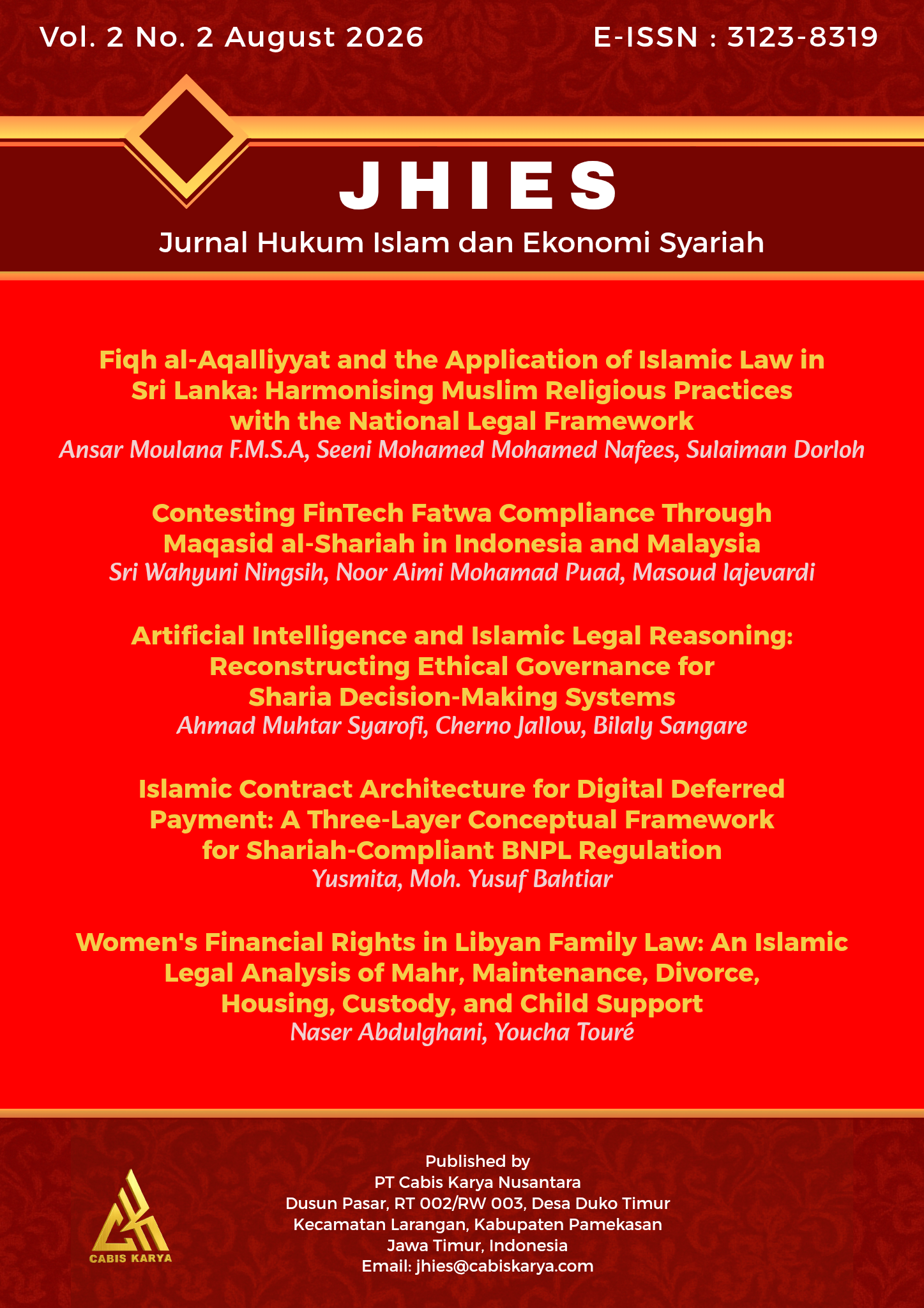
Women's Financial Rights in Libyan Family Law: An Islamic Legal Analysis of Mahr, Maintenance, Divorce, Housing, Custody, and Child Support
DOI:
https://doi.org/10.67140/jhies.v2i2.20Keywords:
Libyan family law, women's financial rights, mahr, maintenance, child supportAbstract
Women's financial rights constitute a central component of Islamic family law and serve as essential mechanisms for protecting economic justice, family stability, and human dignity. This study examines the legal framework governing women's financial rights under Libyan family law through a doctrinal analysis of Law No. 10 of 1984 on Marriage, Divorce and Their Effects, together with its amendments under Law No. 22 of 1991 and Law No. 9 of 1994. The research focuses on six principal areas of financial protection: mahr (dower), maintenance (nafaqah), financial consequences of divorce, housing rights, custody expenses, and child support. Employing qualitative doctrinal legal research, the study interprets the statutory provisions and evaluates their consistency with the Qur'an, the Sunnah, and the objectives of Islamic law (Maqāṣid al-Sharīʿah). The findings indicate that Libyan family law generally reflects Islamic legal principles by recognizing women's independent financial rights and establishing comprehensive mechanisms for protecting them before, during, and after marriage. However, the analysis also identifies legislative ambiguities concerning maintenance assessment, housing enforcement, custody-related financial obligations, compensation, and the adjustment of financial rights to contemporary economic conditions. The study concludes that while the existing legal framework provides substantial protection for women's financial rights, further legislative clarification and stronger enforcement mechanisms are necessary to enhance legal certainty, improve judicial consistency, and strengthen the realization of justice within the Libyan family law system.
Downloads
References
Abrahem, M., & Baroud, N. (2025). Exploring cultural, political, and socioeconomic influences on collective psychological resilience in Libya. Jurnal Ilmu Psikologi dan Kesehatan (SIKONTAN), 3(4), 163–176. https://doi.org/10.47353/sikontan.v3i4.2784
Aktar, S. (2012). Protecting divorced Muslim women's rights through maintenance: A comparative analysis based on the present legislative reforms among the Muslim community. Northern University Journal of Law, 3, 23–48.
Al-Ati, A. M. (2022). Legal protection of women's right to independent marital housing without sharing with others: Articles 25 and 70 of Law No. 10 of 1984 and its amendments in perspective. Journal of Alasmarya University: Sharia and Human Sciences, 35(5), 70–90. https://doi.org/10.59743/jau.v35i5.1464
Alezabi, S., Aladi, S., & Barkah, S. (2026). Montesquieu's political philosophy: The separation of powers and political liberty in the light of good governance and sustainable development. University of Zawia Journal of Legal and Sharia Sciences, 15(1), 20–32. https://journals.zu.edu.ly/index.php/UZJLSS/article/view/1870
Alrumayh, S., Barakat, A., Almuwalif, M., Elhaj, K., & Atia, A. (2025). Content analysis of master's theses at the Faculty of Law, University of Zawia, in light of the (Goal 16) sustainable development. University of Zawia Journal of Legal and Sharia Sciences, 14(2), 117–128. https://doi.org/10.26629/uzjlss.2025.07
Altarhouni, T. A. A., Daud, M. Z., Samah, M., & Kayadibi, S. (2025). Analysing the position of the Libyan inheritance law on preventing women from their inheritance in the light of Shariah. Journal of Shariah Law Research, 10(1), 21–36.
Al-Zuhayli, W. (1989). Al-fiqh al-Islami wa-adillatuh. Dar al-Fikr al-Mouaser.
Atia, A., & Alatrish, E. (2026). The anatomy of governance breakdown: Rethinking authority and regulation in fragile contexts. LAW & PASS: International Journal of Law, Public Administration and Social Studies, 3(1), 22–28. https://doi.org/10.47353/lawpass.v3i1.114
Atia, A., Elhaj, K., & Alhempi, R. R. (2025). Islamic law and human rights revisited: Toward a transformative framework for harmonization in the 21st century. Journal of Contemporary Islamic Law and Studies, 1(1), 1–14. https://doi.org/10.47353/jcils.v1i1.367
Auda, J. (2008). Maqasid al-Shariah: An introductory guide. International Institute of Islamic Thought (IIIT).
Ayad, N., Alrumayh, S., Atia, A., Alatrish, E., Elhaj, K., Hasan, L., ... & Rayhan, A. (2026). Reassessing thamaniyyah in Islamic monetary jurisprudence: Implications of paper currency for zakat and waqf management. ZAWA: Management of Zakat and Waqf Journal, 6(1), 56–73.
Cholis, W. N., & Masuwd, M. A. (2026). Beyond administrative formality: Marriage registration as a maqasid-based legal protection in Indonesia. Al-Syakhsiyyah: Journal of Law and Family Studies, 8(1), 47–68. https://doi.org/10.21154/syakhsiyyah.v8i1.12840
Dawood, S. (2024). Islamic law and gender equality: Challenges and reforms in Sri Lanka's Muslim Marriage and Divorce Act. Journal of Islamic Law, 5, 288.
Hassan, L. A. M. M. (2024). تعويض الضرر المعنوي للتطليق للضرر (دراسة فقهية مقارنة بين الشريعة، والقانون). University of Zawia Journal of Legal and Sharia Sciences, 13(1), 71–98. https://journals.zu.edu.ly/index.php/UZJLSS/article/view/960
Hassan, S. A., & Batool, M. (2024). Concept of 'urf (custom) in Islamic law and its application in social affairs: An analytical study. Mohi-ud-Din Journal of Islamic Studies, 2(1), 1–30.
Hisbullah, H., Syatar, A., & Masuwd, M. (2026). Transformation of siyasah shar'iyyah: An Islamic political ethical framework for mitigating the pathologies of digital power. DIKTUM: Jurnal Syariah dan Hukum, 24(2). https://doi.org/10.35905/diktum.v24i2.16613
Hussain, S. (2013). Unfolding the reality of Islamic rights of women: Mahr and maintenance rights in India. Pakistan Journal of Women's Studies: Alam-e-Niswan, 20(2), 29.
Jubaedah, D., bin Syuhud, I. H., Masuwd, M. A., Patimat, A. P. A., & Jankauskiene, D. (2026). Maqasid-based post-divorce protection: Gender justice reform in Indonesia, Morocco, and Tunisia. Munakahat: Journal of Islamic Family Law, 2(2), 16–29. https://doi.org/10.5281/zenodo.21597981
Jumrotunisak, J., Anwar, K., & Masuwd, M. A. (2026). Disparities in marriage dispensation due to pregnancy: Analysis of vage women norm and maslahah mursalah. Journal of Mathematics Instruction, Social Research and Opinion, 5(1), 797–808. https://doi.org/10.58421/misro.v5i1.1235
Liza, F., Luhuringbudi, T., Ali, A. H., Alrumayh, S. H., & Luhur, M. B. (2026). Reimagining Islamic family law through climate change: The role of Sharia in sustainable household ethics. Islamic Law and Social Issues in Society, 2(1), 79–108. https://doi.org/10.64929/ilsiis.v2i1.33
Masuwd, M., Ayad, N., Alrumayh, S., & Abdulghani, N. (2026a). Triple divorce in a single utterance in Libyan Dar al-Ifta fatwas: The maqasid distribution on institutional duality. Parewa Saraq: Journal of Islamic Law and Fatwa Review, 5(1), 49–62. https://doi.org/10.64016/parewasaraq.v5i1.74
Masuwd, M., Barkah, S., Aladi, S., Alrumayh, S., Hasan, L., Omar, Z., & Ayad, N. (2026b). Polygamy regulation and human rights: The role of judicial governance in Libyan family law. Jurnal Suara Hukum, 8(1), 167–190. https://doi.org/10.26740/jsh.v8n1.p167-190
Mesrati, A. O. A. (2018). 'The best interests of the child': Critical analysis of the Libyan High Court decision. In Research handbook on Islamic law and society (pp. 77–119). Edward Elgar Publishing. https://doi.org/10.4337/9781781003060.00010
Mesrati, A. O. A. (2022). 'The best interests of the child' under the Libyan legal system. In Child rights to guardianship. Springer. https://doi.org/10.1007/978-981-16-8181-3_4
Nasir, J. J. (Ed.). (1990). The Islamic law of personal status. Brill Archive.
Naz, K., & Jahangir, H. (2024). Mahr: An essential component of Islamic matrimony and its legal significance. Al-Marjan (المرجان), 2(3), 59–75.
Oman, N. B. (2011). How to judge Shari'a contracts: A guide to Islamic marriage agreements in American courts. Utah Law Review, 287.
Omar, Z., Alrumayh, S., Elhaj, K., Hasan, L., Alatrish, E., Atia, A., & Abrahem, M. (2026). Islamic family law in Libya under social transformation: A maqasid-oriented socio-legal analysis. JHIES: Jurnal Hukum Islam dan Ekonomi Syariah, 2(1), 17–40.
Onyinyechi, A. P. (2025). A comparative analysis of statutory and customary law marriage in Nigeria: Legal implication for spousal rights (Undergraduate thesis). Alex-Ekwueme Federal University, Faculty of Law.
Pratama, A. R., & Masuwd, M. (2026). Algorithmic due process in the age of generative AI: Developing a human rights-centered transnational framework for judicial accountability and human rights protection. Justicia Insight, 2(2), 36–46. https://doi.org/10.70716/justin.v2i2.375
Raman, D. (2024). Enforceability of mahr under a sharia law-based contract in New Zealand: A comparison with United Kingdom, Australia, and Canada. International Journal of Law, Policy and the Family, 38(1). https://doi.org/10.1093/lawfam/ebae020
Regan, M. C., Jr. (1993). Spouses and strangers: Divorce obligations and property rhetoric. Georgetown Law Journal, 82, 2303.
Salem, A., Mohammed, M., Alrumayh, S., Atia, A., & Sawie, H. (2026). Shariah liability for the risks of using artificial intelligence applications in light of the objectives of Islamic law (Maqasid al-Sharia). University of Zawia Journal of Legal and Sharia Sciences, 15(1), 1–19. https://journals.zu.edu.ly/index.php/UZJLSS/article/view/1869
Shammas, C. (1994). Re-assessing the married women's property acts. Journal of Women's History, 6(1), 9–30.
Showkat, A. (2023). The principle and practice of mahr in Muslim marriages. Feminist Theology, 31(2), 197–209. https://doi.org/10.1177/09667350221134992
Siddiqui, M. (2017). Mahr: Legal obligation or rightful demand? In Issues in Islamic law (pp. 35–45). Routledge.
Ubaidilah, N., & Husna, A. (2023). Regulation of maintenance in Islamic family law: Implications for family welfare. International Journal of Health, Economics, and Social Sciences (IJHESS), 5(4), 601–612.
Welchman, L. (Ed.). (2004). Women's rights and Islamic family law: Perspectives on reform (Vol. 4). Zed Books.
Yogi, Y., Anwar, K., & Masuwd, M. A. (2026). Family financial literacy as a life skill for divorce prevention in Central Kalimantan Province. Al-Sharf: Jurnal Ekonomi Islam, 7(2), 446–471. https://doi.org/10.56114/al-sharf.v7i2.13499
Zaman, N., & Hashmi, M. (2021). Fatawa related to the woman's right of maintenance in Pakistan, India and Egypt: An analysis. Al-Azhar, 7(1), 25–42.
Downloads
Published
Issue
Section
License
Copyright (c) 2026 Naser Abdulghani, Youcha Touré (Author)

This work is licensed under a Creative Commons Attribution-ShareAlike 4.0 International License.