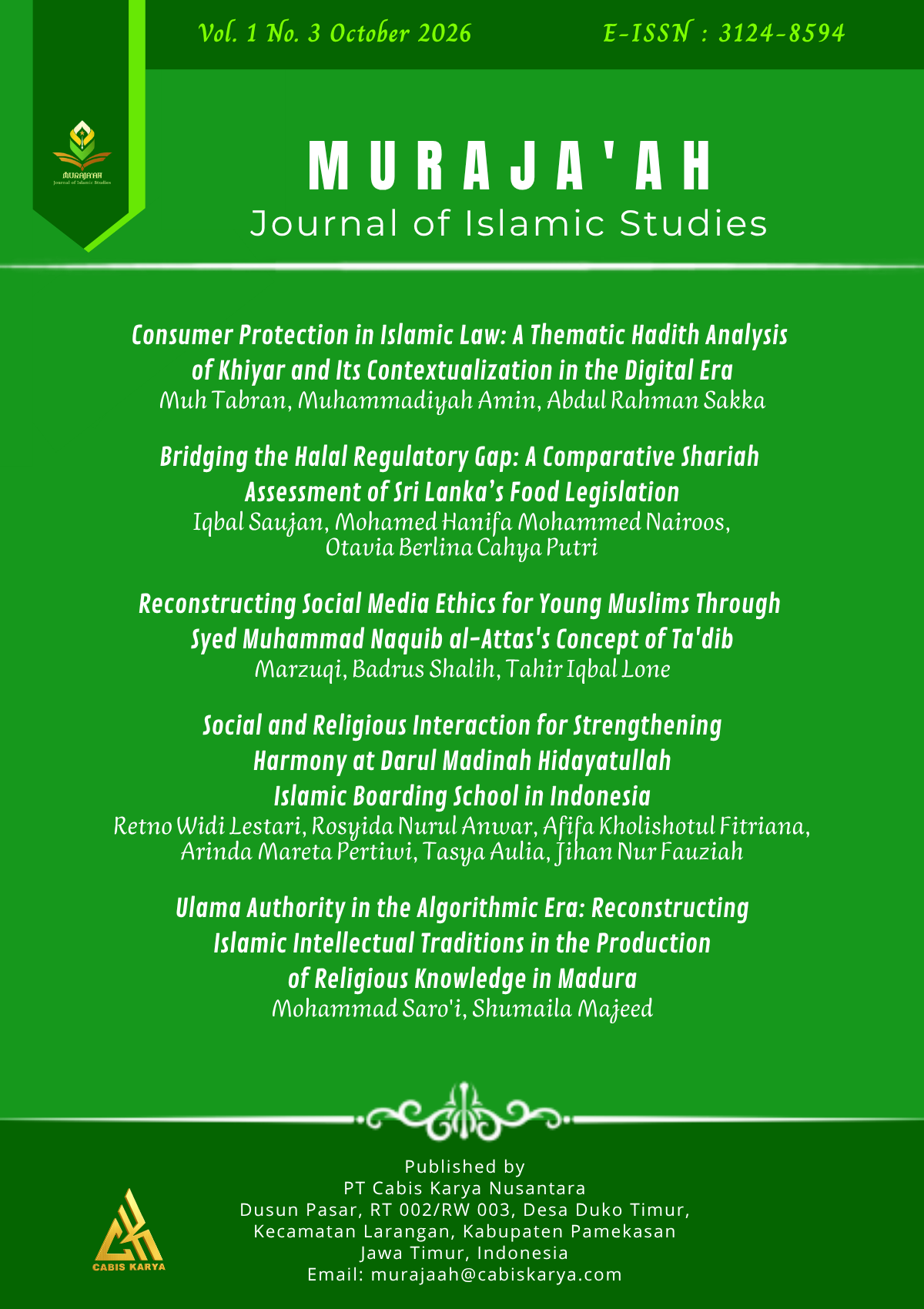
Ulama Authority in the Algorithmic Era: Reconstructing Islamic Intellectual Traditions in the Production of Religious Knowledge in Madura
DOI:
https://doi.org/10.67140/murajaah.v1i3.15Keywords:
ulama authority, islamic intellectual traditions, algorithmic mediationAbstract
Digital transformation has reshaped how religious knowledge is produced, distributed, accessed, and validated, while simultaneously generating new challenges for ulama authority and the continuity of Islamic intellectual traditions. This study aims to analyze how ulama in Madura negotiate scholarly authority within algorithmic environments, how the production and validation of religious knowledge are being reconfigured, and how Islamic intellectual traditions respond to these changes. The study employs a qualitative approach with a multisite case study design conducted in Bangkalan, Sampang, Pamekasan, and Sumenep. Data were collected through in-depth interviews, observations, and analyses of relevant documents and digital traces, and were subsequently analyzed thematically through cross-case comparison. The findings indicate that digital technologies and artificial intelligence do not automatically replace ulama authority; rather, they transform the conditions under which such authority is produced, accessed, and recognized. Digital visibility, audience engagement, and algorithmic mediation interact with scholarly competence, sanad, institutional structures, and community recognition. The study identifies the emergence of hybrid epistemic legitimacy and demonstrates that the reconstruction of Islamic intellectual traditions occurs as a negotiated continuity rather than as the replacement of tradition by technology. These findings position algorithmic transformation as an epistemological issue in contemporary Islamic studies.
Downloads
References
Abusharif, I. N. (2024). Religious knowledge production and digital affordances. Journal of Islamic and Muslim Studies, 9(1), 108-114. https://doi.org/10.2979/jims.00030 DOI: https://doi.org/10.2979/jims.00030
Ahmad, H., & Ghafar, N. A. (2026). Who speaks when machines read scripture: Boundary-making and interpretive authority in AI-mediated religious knowledge. AI Ethics, 6(463). https://doi.org/10.1007/s43681-026-01254-5 DOI: https://doi.org/10.1007/s43681-026-01254-5
Akhmetova, A., Rakhimova, G., Onngar, Y., Issakhan, M., & Baitenova, N. (2026). Digital religion and hybrid religious authority in algorithmically mediated environments. Front. Sociol., 11, 1892383. https://doi.org/10.3389/fsoc.2026.1892383 DOI: https://doi.org/10.3389/fsoc.2026.1892383
Al-Attas., S. M. N. (1998). Islam and secularism. Suhail Academy.
Ali, M., Farih, A., Ayubi, S. Al, & Rosa, A. (2025). Transforming religious authority: Islamic epistemology in the digital age. RUSYDIAH: Jurnal Pemikiran Islam, 6(1), 19–37. https://doi.org/10.35961/rsd.v6i1.2079
Arweck, E. (2016). Exploring religion and the sacred in a media age. Routledge.
Askar, Nurdin, N., Pettalongi, A., Pettalongi, S. S., & Basire, J. H. I. T. (2025). Online Islamic knowledge sources and their authority in Islamic learning: A case study of Indonesian Muslim universities. Cogent Education, 12(1). https://doi.org/10.1080/2331186X.2025.2504236 DOI: https://doi.org/10.1080/2331186X.2025.2504236
Baidawi. (2025). Shaping virtual religious authority: The power of digital media on micro-celebrity da’i. Journal of Asian Wisdom and Islamic Behavior, 3(1), 39–53. https://doi.org/10.59371/jawab.v3i1.93 DOI: https://doi.org/10.59371/jawab.v3i1.93
Berger, A., & Golan, O. (2024). Online religious learning: Digital epistemic authority and self-socialization in religious communities. Learning, Media and Technology, 49(2), 274–289. https://doi.org/10.1080/17439884.2023.2169833 DOI: https://doi.org/10.1080/17439884.2023.2169833
Bognár, B. (2024). Hybrid social spaces and the individualisation of religious experience in the Global North: Spatial aspects of religiosity in postmodern society. Religions, 15(2), 241. https://doi.org/10.3390/rel15020241 DOI: https://doi.org/10.3390/rel15020241
Campbell., H. A. (2013). Digital religion: Understanding religious practice in new media worlds. Routledge. DOI: https://doi.org/10.4324/9780203084861
Campbell, H. A., & Tsuria., R. (2021). Digital religion: Understanding religious practice in digital media (2nd ed.). Routledge. DOI: https://doi.org/10.4324/9780429295683
Chairi, E. (2019). Ketiadaan otoritas terpusat dalam fenomena kontemporer di Indonesia. Radikalisme, Kritik Teori Sosiologi Dan Wacana Politik Di Indonesia, 2(2), 197-215. https://doi.org/10.20414/sangkep.v2i2.666 DOI: https://doi.org/10.20414/sangkep.v2i2.666
Creswell., J. W. (2007). Qualitative inquiry and research design: Choosing among five approaches (2nd ed.). Thousand Oaks, CA: Sage.
Cui, L., Dong, L., Fu, X., Wen, Z., Lu, N., & Zhang, G. (2016). A video recommendation algorithm based on the combination of video content and social network. Concurrency and Computation: Practice and Experience, 29(14), 900. https://doi.org/10.1002/cpe.3900 DOI: https://doi.org/10.1002/cpe.3900
Evolvi, G. (2019). Blogging my religion: Secular, Muslim, and Catholic media spaces in Europe. Routledge. DOI: https://doi.org/10.4324/9780203710067
Goffman, E. (2023). The presentation of self in everyday life. In Social theory re-wired (3rd edn). Routledge. DOI: https://doi.org/10.4324/9781003320609-59
Hannan, A., & Mursyidi, A. F. (2023). Social media and the fragmentation of religious authority among Muslims in contemporary Indonesia. Digital Muslim Review, 1(2). https://doi.org/10.32678/dmr.v1i2.10 DOI: https://doi.org/10.32678/dmr.v1i2.10
Hjarvard, S. (2015). Mediatization and the changing authority of religion. Media, Culture & Society, 38(1), 8-17. https://doi.org/10.1177/0163443715615 DOI: https://doi.org/10.1177/0163443715615412
Lohlker, R., & Wahid, S. H. (2026). The transformation of Islamic religious authority. Religions, 17(4), 493. https://doi.org/10.3390/rel17040493 DOI: https://doi.org/10.3390/rel17040493
Marshall, C., & Rossman., G. B. (2011). Designing qualitative research (5th ed.). Sage.
Maulana, M. D., & Anoraga, B. (2025). Building algorithmic religious authority through different religious networks. Jurnal Dakwah RISALAH, 36(2), 85-110. https://doi.org/10.24014/jdr.v36i2.36050 DOI: https://doi.org/10.24014/jdr.v36i2.36050
Merriam., S. B. (2009). Qualitative research: A guide to design and implementation. Jossey-Bass.
Rafiki, A. (2022). Application of knowledge management and digitalization in an Islamic view. In M. N. Almunawar, M. Z. Islam, & P. Ordóñez de Pablos (Eds.), Digital transformation management: Challenges and futures in the Asian digital economy. Routledge, 2022. https://doi.org/10.4324/9781003224532-6 DOI: https://doi.org/10.4324/9781003224532-6
Salsabilla, N. A., Ma’shumah, N. K., & Wijaya, A. R. (2025). Digital resistance in Indonesia: Critical discourse and sentiment analysis of Kawal Putusan MK on X. Jurnal Gramatika: Jurnal Penelitian Pendidikan Bahasa Dan Sastra Indonesia, 11(1), 132–154. https://doi.org/10.22202/jg.v11i1.8985 DOI: https://doi.org/10.22202/jg.2025.v11i1.8985
Saputra, E., Triantoro, D. A., & Ardiansyah, A. (2021). Urban Muslim youth, pengajian communities and social media: Fragmentation of religious authorities in Indonesia. Al-Qalam Jurnal Penelitian Agama Dan Sosial Budaya, 27(2), 335-345. https://doi.org/10.31969/alq.v27i2.1004 DOI: https://doi.org/10.31969/alq.v27i2.1004
Siregar, K. T., Zhakypkazy, I., & Uyuni, B. (2025). Indonesian muballigh and religious authority: From sanad to algorithmic transformation of Islamic knowledge transmission in the digital era. Jurnal Indo-Islamika, 15(2), 298–314. https://doi.org/10.15408/jii.v15i2.47052 DOI: https://doi.org/10.15408/jii.v15i2.47052
Slama, M. (2017). A subtle economy of time: Social media and the transformation of Indonesia’s Islamic preacher economy. Econ Anthropol, 4(194-106.). https://doi.org/10.1002/sea2.12075 DOI: https://doi.org/10.1002/sea2.12075
Solahudin, D., & Fakhruroji, M. (2020). Internet and Islamic learning practices in Indonesia: Social media, religious populism, and religious authority. Religions, 11(1), 19. https://doi.org/10.3390/rel11010019 DOI: https://doi.org/10.3390/rel11010019
Sulfikar, A., & Yasmine, D. I. (2026). Platformized religious authority: Rethinking legitimacy in the age of social media influencers. Epistemé: Jurnal Pengembangan Ilmu Keislaman, 20(02), 141–171. https://doi.org/10.21274/epis.2025.20.02.141-171 DOI: https://doi.org/10.21274/epis.2025.20.02.141-171
Susanti, R., Nurdiansyah, F., Charles, & Gucandra, Y. (2025). Digitalizing the Quran and Hadith: Epistemological reconstruction and challenges of religious authority in the digital age. El-Rusyd, 10(2), 349–359. https://doi.org/10.58485/elrusyd.v10i2.485 DOI: https://doi.org/10.58485/elrusyd.v10i2.485
Taqwa, R. H., & Lubis, A. A. A. M. R. (2025). Digital religion and hybrid practices: Negotiating ritual and authority within Jama’ah Tabligh in Indonesia. Al-Tahrir Jurnal Pemikiran Islam, 25(2), 323-346. https://doi.org/10.21154/altahrir.v25i2.11599 DOI: https://doi.org/10.21154/altahrir.v25i2.11599
Tuna, M. H., Kolb, J., & Sejdini, Z. (2023). Religious learning environments of Austrian Muslim youth: An empirical analysis of religious educational processes. Religions, 14(8), 1002. https://doi.org/10.3390/rel14081002 DOI: https://doi.org/10.3390/rel14081002
Wahid, S. H., & Abdulloh, S. (2026). Digital Islamic authority: A revolutionary shift or mere hype? A systematic review. SN Social Sciences, 6(62). https://doi.org/10.1007/s43545-026-01328-5 DOI: https://doi.org/10.1007/s43545-026-01328-5
Yin., R. K. (2018). Case study research and applications: Design and methods (4th ed.). SAGE Publications.
Zaid, B., Fedtke, J., Shin, D. D., Kadoussi, A. El, & Ibahrine, M. (2022). Digital Islam and Muslim millennials: How social media influencers reimagine religious authority and Islamic practices. Religions, 13(4), 335. https://doi.org/10.3390/rel13040335 DOI: https://doi.org/10.3390/rel13040335
Zaid, B., Ibahrine, M., & Moussa, M. Ben. (2022). Networked Islam and liquid authority: Everyday influencers and young Muslim practice. Religions, 13(4), 1–15. https://doi.org/10.1177/14614448261436035
Zairina, W., Zamzami, M., Muktafi, M., Albaar, A., & Hegazy, W. (2025). Contesting infidelity and religious authority in digital Indonesia: The discursive contestation of the hadith al-Ḥamw al-Mawt on social media. Journal of Contemporary Islam and Muslim Societies, 9(2). https://doi.org/10.30821/jcims.v9i2.26651 DOI: https://doi.org/10.30821/jcims.v9i2.26651
Downloads
Published
Issue
Section
License
Copyright (c) 2026 Mohammad Saro'i, Shumaila Majeed (Author)

This work is licensed under a Creative Commons Attribution-ShareAlike 4.0 International License.