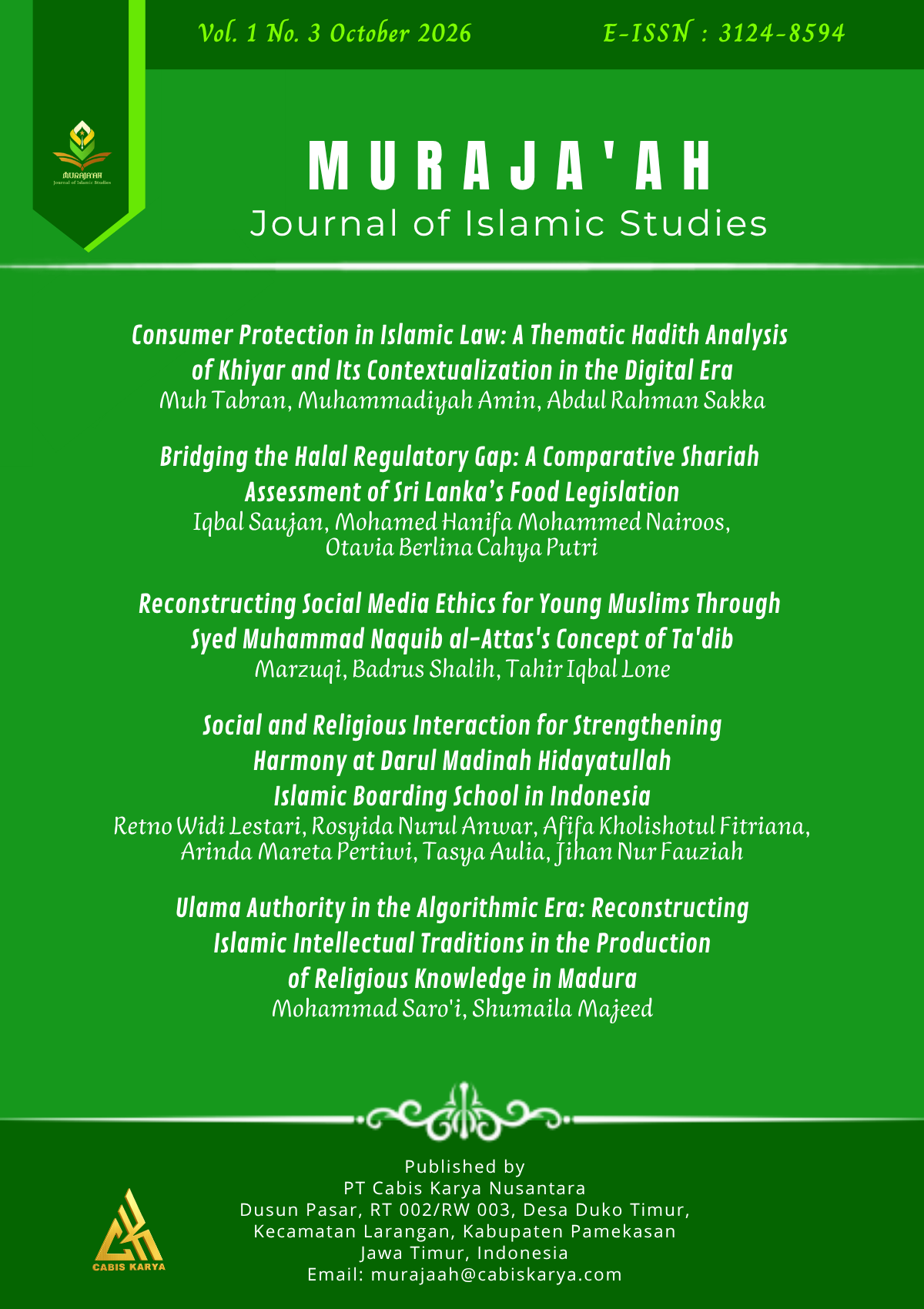
Bridging the Halal Regulatory Gap: A Comparative Shariah Assessment of Sri Lanka’s Food Legislation
DOI:
https://doi.org/10.67140/murajaah.v1i3.12Keywords:
halal labelling, halal certification, halal standards, food actAbstract
Global Halal Standards (GHS) serve as a reference for countries worldwide to ensure that products comply with Islamic law (Shariah) while supporting international trade. In Sri Lanka, the presence of a multi-ethnic and multi-religious population necessitates halal regulations that protect consumers without disregarding social diversity. This study aims to analyze the adequacy of the Food Act No. 26 of 1980 and the Consumer Affairs Authority (CAA) Act No. 9 of 2003 in meeting Shariah-based halal requirements. It employs a qualitative, library-based research method by comparing Sri Lanka’s regulations with halal governance models in Malaysia, Indonesia, the United Arab Emirates (UAE), and the European Union (EU). The analysis focuses on the legal definition of halal, Shariah-compliant slaughter, the purity of ingredients and processing procedures, the prevention of cross-contamination, and halal certification and labeling. The findings reveal four major regulatory gaps: the absence of a legally established definition of halal, the lack of an adequately regulated certification system, insufficient provisions for preventing cross-contamination, and the absence of mandatory halal labeling. This study recommends legislative amendments, the establishment of national halal standards, and the creation of a National Halal Accreditation Body involving accredited certification bodies and a technical advisory committee. These reforms are grounded in Maqasid al-Shariah and the principle of maslahah (public interest) to strengthen consumer protection, facilitate access to international markets, and preserve social harmony in Sri Lanka.
Downloads
References
Ahmad, B. (2019). Penentuan kifayah adna sebagai jaminan nafkah isteri di dalam Islam: Kajian kes di Lembah Klang, Malaysia. UMRAN: International Journal of Islamic and Civilizational Studies, 6(2), 111–126. https://doi.org/10.11113/umran2019.6n2.261 DOI: https://doi.org/10.11113/umran2019.6n2.261
Aini, N., Ardiani, F., & Hanastiana, M. R. (2020). Halal food industry: Challenges and opportunities in Europe. Journal of Digital Marketing and Halal Industry, 2(1), 43–54. https://doi.org/10.21580/jdmhi.2020.2.1.5799 DOI: https://doi.org/10.21580/jdmhi.2020.2.1.5799
Al-Haq-Halal. (2013). Muslim slaughter. Halal Slaughter & Control Company. http://briansoft.home.pl/autoinstalator/wordpress/?page_id=2441&lang=en
Al-mahmood, O. A. (2020). Microbiological safety of halal beef in the United States (All Dissertations, No. 2574). Clemson University TigerPrints. https://tigerprints.clemson.edu/all_dissertations/2574
Alsolami, M. H. (2020). The Rome Statute and Islamic law: A comparative analysis with special reference to Saudi Arabia. Brill.
Arab News. (2013). Halal food label withdrawn in Sri Lanka after protests. https://www.arabnews.com/news/444534
Arnold, M., Wickramatilake, S., Fernando, D., Sampath, R., Mahesh, B., Fernando, Y., & Denawaka, C. (2020). Health and nutrition related claims of non-alcoholic beverage labels in supermarkets: Their compliance with Sri Lanka Food Labelling and Advertising Regulations. Journal of the College of Community Physicians of Sri Lanka, 26(1), 29–34. DOI: https://doi.org/10.4038/jccpsl.v26i1.8222
Awan, J. A., & Fazal, S. (2018). Animal rights and welfare in Islam. International Journal of Avian & Wildlife Biology, 3(6), 427–430. https://doi.org/10.15406/ijawb.2018.03.00135 DOI: https://doi.org/10.15406/ijawb.2018.03.00135
Azam, M. S. E., & Abdullah, M. A. (2021). Halal standards globally: A comparative study of unities and diversities among the most popular halal standards globally. Halalsphere, 1(1), 11–31. https://doi.org/10.31436/hs.v1i1.20 DOI: https://doi.org/10.31436/hs.v1i1.20
Aziz, N. I. A., & Ahmad, F. A. (2018). The halal lifestyle of Muslim working women. International Journal of Academic Research in Business and Social Sciences, 8(5). https://doi.org/10.6007/ijarbss/v8-i5/4489 DOI: https://doi.org/10.6007/IJARBSS/v8-i5/4489
Baig, M. A., & Ali, S. N. (2020). The expanding scope and scale of the halal market. JKAU: Islamic Economics, 33(2), 159–172. https://doi.org/10.4197/Islec.33-2.12
Bashir, A. M. (2022). Awareness of purchasing halal food among non-Muslim consumers: An exploratory study with reference to Cape Town of South Africa. Journal of Islamic Marketing. https://doi.org/10.1108/JIMA-04-2018-0077 DOI: https://doi.org/10.1108/JIMA-04-2018-0077
Department of Census and Statistics. (2023). Economic crisis takes its toll on education, DCS survey reveals. LankaWeb. https://www.lankaweb.com/news/items/2023/12/28/economic-crisis-takes-its-toll-on-education-dcs-survey-reveals/
Deuraseh, N. (2016). Review article: Lawful and unlawful foods in Islamic law: Focus on Islamic medical and ethical aspects. International Food Research Journal, 16, 469–478. https://www.researchgate.net/profile/Nurdeng-Deuraseh/publication/303878782
Dewi, I. P. (2023). P Pengaruh efektivitas kerja dan kompetensi terhadap kinerja pegawai Badan Penyelenggara Jaminan Produk Halal (BPJPH). Innovative: Journal of Social Science Research, 3(3), 3276–3288. https://j-innovative.org/index.php/Innovative/article/view/2492
Djunaidi, M., Baby, C., Oktavia, A., Fitriadi, R., & Setiawan, E. (2021). Perception and consumer behavior of halal product toward purchase decision in Indonesia. Jurnal Teknik Industri, 22(2), 171–184. https://doi.org/10.22219/JTIUMM.Vol22.No2.171-184 DOI: https://doi.org/10.22219/JTIUMM.Vol22.No2.171-184
Emon, A. M., & Ahmed, R. (Eds.). (2025). The Oxford handbook of Islamic law. Oxford University Press.
Farah, M. (2020). Consumer perception of halal products: An empirical assessment among Sunni versus Shiite Muslim consumers. Journal of Islamic Marketing. https://doi.org/10.1108/JIMA-09-2019-0191 DOI: https://doi.org/10.1108/JIMA-09-2019-0191
Fayokemi, W. (2022). Food prohibition in Islam: A step towards good health. International Journal of Scientific and Research Publications, 10(2), 84–88. https://doi.org/10.29322/IJSRP.10.02.2020.p9814 DOI: https://doi.org/10.29322/IJSRP.10.02.2020.p9814
Food Act No. 26 of 1980 (Sri Lanka). https://eohfs.health.gov.lk/food/images/pdf/acts/food_act_no26_1980_en.pdf
Hamzah, D. (2023). International law and Muslim states: Saudi Arabia in context. Routledge.
Henderson, J. C. (2016). Halal food, certification and halal tourism: Insights from Malaysia and Singapore. Tourism Management Perspectives, 19, 160–164. https://doi.org/10.1016/j.tmp.2015.12.006 DOI: https://doi.org/10.1016/j.tmp.2015.12.006
Hettiarachchi, C. A. (2022). Comparative analysis of Sri Lankan and Indian Food Acts: Legislative consistencies and inconsistencies. Journal of the Postgraduate Institute of Medicine, 2(2), 106–125. https://doi.org/10.21154/invest.v2i2.3946 DOI: https://doi.org/10.21154/invest.v2i2.3946
Hussain, I. (2013). Halal problem in Sri Lanka is almost certainly unique because of its sheer quasi-insane irrationality. DBS Jeyaraj. https://dbsjeyaraj.com/dbsj/?p=18513
Kamali, M. H. (2005). Principles of Islamic jurisprudence. Islamic Texts Society.
Khan, M. I., & Haleem, A. (2016). Understanding “halal” and “halal certification & accreditation system”: A brief review. Saudi Journal of Business and Management Studies, 1(1), 32–42. http://scholarsmepub.com/sjbms/ DOI: https://doi.org/10.36348/sjbms.2020.v05i01.005
Kızılkaya, N. (2021). Legal maxims in Islamic law: Concept, history and application of axioms of juristic accumulation. Brill. DOI: https://doi.org/10.1163/9789004444676
Kolamunna, T., & Dissanayake, C. A. K. (2023). Awareness of and compliance with the Food Act in Sri Lanka: An analysis of the present status. Journal of Agricultural Sciences–Sri Lanka, 18(3), 388–406. https://doi.org/10.4038/jas.v18i3.9850 DOI: https://doi.org/10.4038/jas.v18i3.9850
Latif, I. A., Mohamed, Z., Sharifuddin, J., & Mahir, A. (2014). A comparative analysis of global halal certification requirements. Journal of Food Products Marketing, 20(S1), 85–101. https://doi.org/10.1080/10454446.2014.921869 DOI: https://doi.org/10.1080/10454446.2014.921869
Lumpur, K. (2017). The concept and components of contaminated animals (al-jallalah animals). International Food Research Journal, 24(Suppl.), 436–440. http://www.ifrj.upm.edu.my/
Miswanto, A. (2023). Investigating al-istihalah in the provisions of Shariah texts: A study on models of transformation from impure (najis) to pure (halal) substances, or vice versa. Jurnal Hukum Bisnis Islam, 15(1), 1–25. DOI: https://doi.org/10.14421/azzarqa.v15i1.2731
Murti, T. W. (2017). Halal lifestyle and global trade. In The 7th International Seminar on Tropical Animal Production: Contribution of Livestock Production on Food Sovereignty in Tropical Countries (Vol. 2, pp. 33–39).
Nandala, I. M., & Azrak, T. (2024). Halal certification: Legal and ethical consideration in Islamic jurisprudence. International Journal of Islamic Business, 9(2), 43–60. https://doi.org/10.32890/ijib2024.9.2.4 DOI: https://doi.org/10.32890/ijib2024.9.2.4
Rashid, R. A., & Kamarudin, K. (2024). Reasons for the prohibition of foods: A hadith jurisprudential study. BITARA International Journal of Civilizational Studies and Human Sciences, 7(4), 72–85.
Rathnathilake, T., Thiel, F., Logistics, H. W., & Weerakkody, J. (2017). Analysis of MSW compost on compliance with Sri Lanka Quality Standards: Analysis of municipal solid waste compost on compliance with Sri Lanka Quality Standards (SLS 1246: 2003). In Proceedings of the 16th Agricultural Research Symposium (2017) (pp. 1–5). https://www.researchgate.net/profile/Jayantha-Weerakkody-2/publication/335790853
Razick, A. S., Long, A. S., & Salleh, K. (2016). Post-tension relationship between Buddhists and Muslims in Sri Lanka. Research on Humanities and Social Sciences, 6(3), 107–117. https://doi.org/10.5901/mjss.2015.v6n4s2p278 DOI: https://doi.org/10.5901/mjss.2015.v6n4s2p278
Rezwan. (2013). Hardline Buddhists drive Sri Lanka to drop Muslim halal labeling. Global Voices. https://globalvoices.org/2013/03/22/hardline-buddhists-drive-sri-lanka-to-drop-muslim-halal-labeling/
Rizuan, M., & Kadir, A. (2020). Tracing the cost components in halal standard MS 1500: 2019 for production efficiency. Journal of Energy & Environment, 12(2). https://journal.uniten.edu.my/index.php/jee/article/view/213
Saidin, N., Rahman, F. A., & Abdullah, N. (2017). Animal feed: Halal perspective. In Proceedings of the International Conference on Humanities, Social Sciences and Education (pp. 20–21). https://doi.org/10.17758/URUAE.UH0317018 DOI: https://doi.org/10.17758/URUAE.UH0317018
Sains, U., Mahyeddin, M., & Sains, U. (2017). The possibility of uniformity on halal standards in Organization of Islamic Cooperation (OIC) countries. World Applied Sciences Journal, 17, 6–10.
Sarjoon, A., Yusoff, M., & Hussin, N. (2016). Anti-Muslim sentiments and violence: A major threat to ethnic reconciliation and ethnic harmony in post-war Sri Lanka. Religions, 7(10), Article 125. https://doi.org/10.3390/rel7100125 DOI: https://doi.org/10.3390/rel7100125
Saujan, I., Razick, A. S., Long, A. S., & Jubba, H. (2025). The halal value chain in Sri Lanka: Economic contribution amidst institutional and legal controversies. JURIS (Jurnal Ilmiah Syariah), 24(2), 249–264. https://doi.org/10.31958/juris.v24i2.15860 DOI: https://doi.org/10.31958/juris.v24i2.15860
Saujan, I., Sifkan, M. H., Nimsith, S. I., & Nafees, S. M. M. (2025). E Exploring community perceptions of halal slaughtering: Its impact on family and social obligations in Ampara District, Sri Lanka. Quru’: Journal of Family Law and Culture, 3(1), 53–72. https://doi.org/10.59698/quru.v3i1.370 DOI: https://doi.org/10.59698/quru.v3i1.370
Siddiq, A., Mashudi, M., Junaidi, M. A., & Maula, I. (2021). Exploring the interaction among MUI, Fatwa Commission and LP POM MUI on halal products (A study on public response to halal product certification and its factors). Multicultural Education, 7(12), 230–240. https://doi.org/10.5281/zenodo.5784219
Sofiana, R., Utama, S., & C, A. R. (2024). The problems of halal certification regarding consumer protection in Malaysia and Indonesia. Journal of Human Rights, Culture and Legal System, 1(3), 176–189. https://doi.org/10.53955/jhcls.v1i3.16 DOI: https://doi.org/10.53955/jhcls.v1i3.16
Sucipto, S., Hidayati, L., Perdani, C. G., & Hasanah, N. (2021). Traceability of halal control point in material, production, and serving to support halal certification in Universitas Brawijaya canteen. Indonesian Journal of Halal Research, 2(3), 75–86. https://doi.org/10.15575/ijhar.v3i2.11401 DOI: https://doi.org/10.15575/ijhar.v3i2.11401
Tao, L. (2024). Malaysian halal food regulation. Chemlinked. https://food.chemlinked.com/foodpedia/malaysian-halal-food-regulation
Yakar, E. E. (2023). Islamic law and society: The practice of iftā’ and religious institutions. Routledge. DOI: https://doi.org/10.52541/isiri.v62i3.2773
You, A., Be, M., & In, I. (2024). Text mining related to halal implementation in UU Cipta Kerja and UU Halal Product Guarantee No. 33/2014. In Proceedings of the 6th International Conference on Computing and Applied Informatics 2022, (Article 020036). https://doi.org/10.1063/5.0200483 DOI: https://doi.org/10.1063/5.0200483
Yusoff, M. A., & Sarjoon, A. (2017). Anti-halal and anti-animal slaughtering campaigns and their impact in post-war Sri Lanka. Religions, 8(4), 1–15. https://doi.org/10.3390/rel8040046 DOI: https://doi.org/10.3390/rel8040046
Zakaria, Z., & Ismail, S. Z. (2014). The Trade Description Act 2011: Regulating “halal” in Malaysia. In International Conference on Law, Management and Humanities (ICLMH ’14) (pp. 21–23).
Zakaria, Z., & Ismail, S. Z. (2015). The development of regulations concerning halal through Trade Description Act 2011 in Malaysia. Jurnal Syariah, 23(2), 189–216. https://ir.uitm.edu.my/id/eprint/28194/ DOI: https://doi.org/10.22452/js.vol23no2.1
Downloads
Published
Issue
Section
License
Copyright (c) 2026 Iqbal Saujan, Mohamed Haniffa Mohamed Nairoos, Otavia Berlina Cahya Putri (Author)

This work is licensed under a Creative Commons Attribution-ShareAlike 4.0 International License.