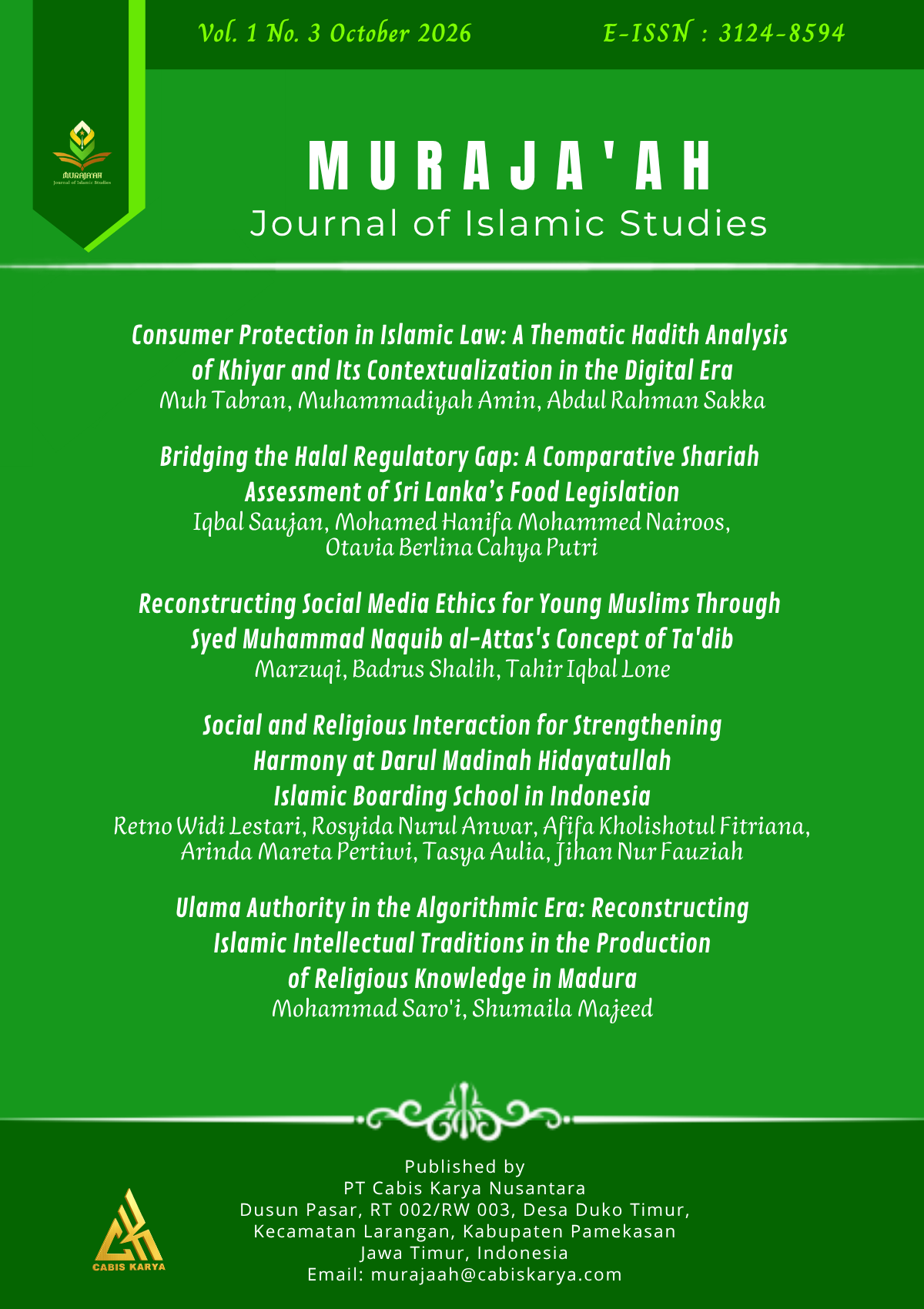
Reconstructing Social Media Ethics for Young Muslims Through Syed Muhammad Naquib al-Attas's Concept of Ta'dib
DOI:
https://doi.org/10.67140/murajaah.v1i3.13Keywords:
Digital ethics, social media, muslim youth, ta'dib, islamic educationAbstract
Social media use among Muslim youth is often linked to misinformation, cyberbullying, and weakening shame (haya'). Islamic responses tend either to list prohibitions or to adapt secular digital-ethics frameworks, and the few studies that apply Syed Muhammad Naquib al-Attas's ta'dib to digital ethics remain largely at the level of values. This article asks why rule-based approaches fall short and how ta'dib can become an operational framework for social media ethics. It uses a qualitative systematic literature review with framework synthesis, drawing on al-Attas's primary works and a screened corpus of scholarly sources published between 2000 and 2026, coded through six-phase thematic analysis. Three findings emerge. First, speed, anonymity, and attention-driven design weaken the three conditions on which ta'dib depends: recognition of the proper order of things, exemplary models, and God-consciousness. Second, tabayyun, amanah, qawl sadid, and muraqabah operate as an ordered sequence of receiving, holding, expressing, and self-monitoring, each with observable indicators. Third, these principles can be implemented through a Ta'dib-Based Pedagogical Framework for Digital Ethics covering curriculum, pedagogy, teacher formation, institutional culture, and family-community partnership. The framework complements rather than replaces governance-oriented digital ethics. Its propositions remain to be tested empirically.
Downloads
References
Ahmad, N., Ma, M. K., Rahman, S. F. A., Mahmood, S. R. S., Razak, N. A. M., & Mohamad, S. N. A. (2025). The Islamic ethical principles and maqasid al-shariah to enhance digital competency among adolescents. UMRAN - Journal of Islamic and Civilizational Studies, 12(3), 101–117. https://doi.org/10.11113/umran2025.12n3.833 DOI: https://doi.org/10.11113/umran2025.12n3.833
Al-Attas, S. M. N. (1993). Islam and secularism. International Institute of Islamic Thought and Civilization (ISTAC).
Al-Attas, S. M. N. (1995). Prolegomena to the metaphysics of Islam: An exposition of the fundamental elements of the worldview of Islam. ISTAC.
Al-Attas, S. M. N. (1999). The concept of education in Islam: A framework for an Islamic philosophy of education (3rd impression). ISTAC.
Booth, A., Sutton, A., & Papaioannou, D. (2016). Systematic approaches to a successful literature review (2nd ed.). SAGE.
Braun, V., Clarke, & V. (2006). Using thematic analysis in psychology. Qualitative Research in Psychology. https://doi.org/10.1191/1478088706qp063oa DOI: https://doi.org/10.1191/1478088706qp063oa
Bunt, G. R. (2018). Hashtag Islam: How cyber-Islamic environments are transforming religious authority. University of North Carolina Press. DOI: https://doi.org/10.5149/northcarolina/9781469643168.001.0001
Campbell, H. A., & Tsuria, R. (2021). Digital religion: Understanding religious practice in digital media (2nd ed.). Routledge. DOI: https://doi.org/10.4324/9780429295683
Creswell, J. W., & Poth, C. N. (2018). Qualitative inquiry and research design: Choosing among five approaches (4th ed.). SAGE.
Creswell, & W., J. (2017). Research design : Pendekatan metode kualitatif, kuantitatif, dan campuran. Pustaka Pelajar.
Fika, B. A., Ahadiyah, F. H., & Supriyatno, T. (2026). Konsep ta’dib Syed Naquib al-Attas sebagai penguatan etika digital dalam pendidikan Islam kontemporer. Pendas: Jurnal Ilmiah Pendidikan Dasar, 11(1), 187–203. https://doi.org/10.23969/jp.v11i01.42551
Floridi, L. (2018). Soft ethics and the governance of the digital. Philosophy & Technology, 31(1), 1–8. https://doi.org/10.1007/s13347-018-0303-9 DOI: https://doi.org/10.1007/s13347-018-0303-9
Halstead, J. M. (2004). An Islamic concept of education. Comparative Education, 40(4), 517–529. https://doi.org/10.1080/0305006042000284510 DOI: https://doi.org/10.1080/0305006042000284510
Hidayatullah, E. A., & Arif, S. (2022). Syed Muhammad Naquib al-Attas’ exposition on the concept of ethics. Afkar, 24(1), 409–446. https://doi.org/10.22452/afkar.vol24no1.12 DOI: https://doi.org/10.22452/afkar.vol24no1.12
In’ami, M., Bambang, & Wekke, I. S. (2025). Contextualising adab in Islamic education from the perspective of Al-Attas. Journal of Al-Tamaddun, 20(1), 145–158. https://doi.org/10.22452/JAT.vol20no1.11 DOI: https://doi.org/10.22452/JAT.vol20no1.11
Indonesia, C. N. N. (2021). Riset: Netizen di Indonesia paling tak sopan se-Asia Tenggara. https://www.cnnindonesia.com/teknologi/20210225115954-185-610735/riset-netizen-di-indonesia-paling-tak-sopan-se-asia-tenggara
Jabareen, Y. (2009). Building a conceptual framework: Philosophy, definitions, and procedure. International Journal of Qualitative Methods, 8(4), 49–62. https://doi.org/10.1177/160940690900800406 DOI: https://doi.org/10.1177/160940690900800406
Kowalski, R. M., Giumetti, G. W., Schroeder, A. N., & Lattanner, M. R. (2014). Bullying in the digital age: A critical review and meta-analysis of cyberbullying research among youth. Psychological Bulletin, 140(4), 1073–1137. https://doi.org/10.1037/a0035618 DOI: https://doi.org/10.1037/a0035618
Maysurah, M., Maimun, M., Suyyirah, S., & Aini, N. (2025). Pendidikan agama Islam di era post-truth: Upaya penguatan karakter siswa melalui literasi digital. Al-Aulia: Jurnal Pendidikan Dan Ilmu-Ilmu Keislaman, 11(2), 188–201. https://doi.org/10.46963/aulia.v11i2.3448 DOI: https://doi.org/10.46963/aulia.v11i2.3448
Murniasih, E., Wasehudin, W., Patimah, S., & Pebrina, R. (2025). Integration of digital ethics into Islamic religious education: A case study at vocational high school. Ta’dib, 28(2), 411–426. https://doi.org/10.31958/jt.v28i2.15404 DOI: https://doi.org/10.31958/jt.v28i2.15404
Page, M. J., McKenzie, J. E., Bossuyt, P. M., Boutron, I., Hoffmann, T. C., Mulrow, C. D., & Moher, D. (2021). The PRISMA 2020 statement: An updated guideline for reporting systematic reviews. BMJ, 372, n71. https://doi.org/10.1136/bmj.n71 DOI: https://doi.org/10.1136/bmj.n71
Przybylski, A. K., Murayama, K., DeHaan, C. R., & Gladwell, V. (2013). Motivational, emotional, and behavioral correlates of fear of missing out. Computers in Human Behavior, 29(4), 1841–1848. https://doi.org/10.1016/j.chb.2013.02.014 DOI: https://doi.org/10.1016/j.chb.2013.02.014
Ramadhan, M., Mukmin, M., & Syahrul, S. (2025). Media sosial dan degradasi akhlak: Respons pendidikan Islam di Indonesia. Jurnal Intelek Dan Cendikiawan Nusantara, 2(4), 6706–6713.
Sahin, A. (2018). Critical issues in Islamic education studies: Rethinking Islamic and Western liberal secular values of education. Religions, 9(11), 335. https://doi.org/10.3390/rel9110335 DOI: https://doi.org/10.3390/rel9110335
Snyder, H. (2019). Literature review as a research methodology: An overview and guidelines. Journal of Business Research, 104, 333–339. https://doi.org/10.1016/j.jbusres.2019.07.039 DOI: https://doi.org/10.1016/j.jbusres.2019.07.039
Suler, J. (2004). The online disinhibition effect. CyberPsychology & Behavior, 7(3), 321–326. https://doi.org/10.1089/1094931041291295 DOI: https://doi.org/10.1089/1094931041291295
Vosoughi, S., Roy, D., & Aral, S. (2018). The spread of true and false news online. Science, 359(6380), 1146–1151. https://doi.org/10.1126/science.aap9559 DOI: https://doi.org/10.1126/science.aap9559
Wahyudi, M. Z. (2021). Unprepared for cyberspace. https://www.kompas.id/baca/english/2021/03/29/unprepared-for-cyberspace/
Wan Daud, W. M. N. (1998). The educational philosophy and practice of Syed Muhammad Naquib al-Attas. ISTAC.
Yunita, I., Saidah, A., & Fahmi, M. (2025). The imperative of integrating knowledge and adab in reconstructing Islamic education in the digital era: A study of Al-Attas’s thought. J-PAI: Jurnal Pendidikan Agama Islam, 11(2), 123–134. https://doi.org/10.18860/jpai.v11i2.32660 DOI: https://doi.org/10.18860/jpai.v11i2.32660
Zarman, W. (2023). Adab terhadap informasi digital sebagai kerangka pikir pendidikan Islam tentang etika penggunaan teknologi informasi. Ta’dibuna: Jurnal Pendidikan Islam, 12(5), 456–471. https://doi.org/10.32832/tadibuna.v12i5.15028 DOI: https://doi.org/10.32832/tadibuna.v12i5.15028
Zuboff, S. (2019). The age of surveillance capitalism: The fight for a human future at the new frontier of power. PublicAffairs.
Downloads
Published
Issue
Section
License
Copyright (c) 2026 Marzuqi, Badrus Shalih, Tahir Iqbal Lone (Author)

This work is licensed under a Creative Commons Attribution-ShareAlike 4.0 International License.